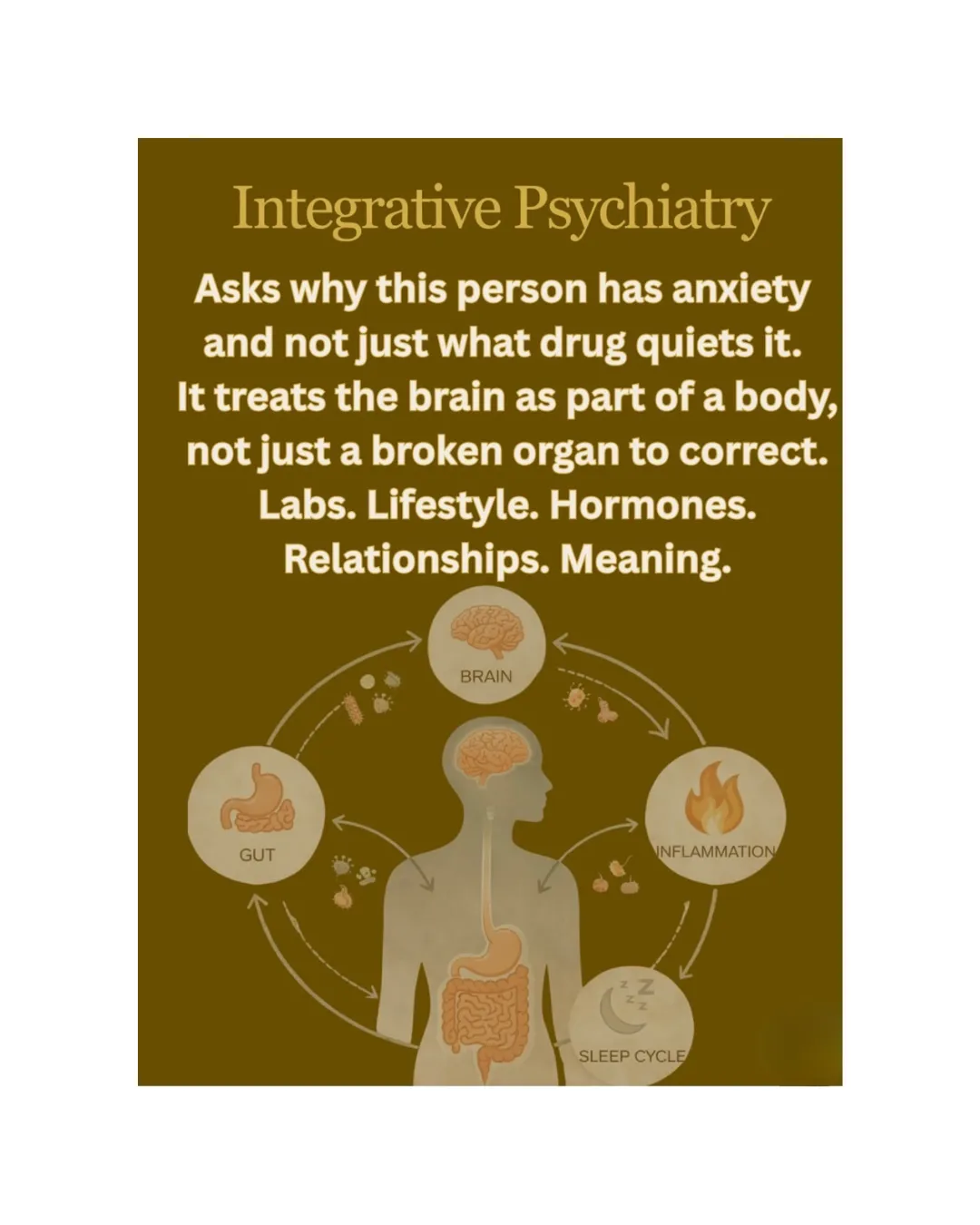
What Is Integrative Psychiatry? How It's Different From a Regular Psychiatrist
Integrative psychiatry combines conventional psychiatric medicine with evidence-based approaches that address root causes, including hormonal imbalances, inflammation, gut health, trauma, and lifestyle factors. It differs from traditional psychiatry in that it does not stop at symptom management. It asks why your symptoms are happening and treats the whole person, not just the diagnosis.
The System Has a Ceiling
Traditional psychiatry is not the enemy. I want to be clear about that. The system has produced life-saving treatments, and I trained inside it for a reason. But it also has a ceiling, and a lot of women are pressing their heads against it without knowing it.
That ceiling looks like this: a 15-minute medication management appointment. A prescription that is adjusted based on what you report feeling, not on what is happening inside your body. A model that treats your mind as separate from your hormones, your gut, your nervous system, and your history. A framework where the goal is to get you functional, and not restored.
I built Restored Radiance Integrative Psychiatry because I believe you deserve more than the ceiling.
So What Is Integrative Psychiatry, Actually?
Integrative psychiatry is a model of care that holds conventional psychiatric knowledge alongside a broader investigation of what is driving your mental health symptoms. It does not replace medication when medication is needed. It expands the conversation to include everything else that conventional psychiatry often overlooks.
That includes hormones, including your cycle, your perimenopause transition, your postpartum body, your stress load, and the cultural context you live in. It includes gut health and the gut-brain connection, which has a significant and growing body of research behind it. It includes inflammation, sleep architecture, nutrient status, trauma history, and how your nervous system was shaped by your earliest experiences.
In short, integrative psychiatry asks: what is your body trying to tell you, and what has the traditional system been too narrow to hear?
How It Differs From a Traditional Psychiatrist
In a traditional psychiatric model, the visit typically looks like this: you describe your symptoms, your provider considers which medication or combination of medications best addresses those symptoms, they write a prescription, and they see you again in a month or three months to assess whether it is working.
That model can absolutely be helpful. But it has significant limitations.
It does not ask why you are depressed. It assumes the depression is the starting point rather than a signal. It does not consider whether your low mood is connected to a hormonal shift in your luteal phase every month. It does not explore whether your anxiety is worsened by a thyroid imbalance that showed up in your labs but was dismissed because the numbers were technically in range. It does not look at whether your brain fog and fatigue are connected to gut dysbiosis or chronic inflammation.
Integrative psychiatry asks all of those questions. It treats your labs not as a pass-or-fail but as data, and it uses a broader set of tools to interpret what your body is communicating.
What an Integrative Psychiatric Evaluation Actually Includes
When I work with a new client, I am not just collecting symptom data to match it to a diagnostic code. I am building a picture of you, how you sleep, how you eat, what your cycle looks like, what your stress history has been, what medications or supplements you are already taking, what has been tried before, and why it did not work.
I look at labs, not just to see if you are in the normal range, but to understand your optimal range. There is a difference between a thyroid that is technically functioning and a thyroid that is functioning well for you. I consider the role of cortisol, estrogen, progesterone, testosterone, and how shifts in those hormones interact with neurotransmitter function.
I also hold the whole person. This includes your resilience and your nervous system patterns. The ways your history is living in your body right now. Because none of that is separate from your mental health.
Is Medication Part of Integrative Psychiatry?
Yes, and this matters. Integrative psychiatry does not have a philosophical opposition to medication. Medication is a tool. Sometimes it is the right tool. Sometimes it is the only tool that can create enough stability for other healing to happen.
What integrative psychiatry does differently is treat medication as part of a larger plan, not the whole plan. The goal is not to keep you on medication indefinitely if that is not what you need. The goal is to understand your situation fully enough that every intervention, including medication if it is used, is targeted and purposeful.
I often work with women who want to reduce their medication over time as we address the underlying root causes. That is a legitimate goal, and one I can support safely when the clinical picture supports it.
Who Integrative Psychiatry Is For
Integrative psychiatry is particularly well-suited for women who feel like they have tried the conventional path and are still searching. The woman who has been on antidepressants for five years and is better, but not well. The woman who knows her mood shifts with her cycle but has never had a provider take that seriously. The woman who has had every lab run and been told everything is normal, but she knows in her bones that something is off.
It is also for women who want to understand their mental health at a deeper level before jumping to medication, or who want to approach their care holistically from the beginning.
If any of that sounds like you, this is what you have been looking for.
Ready to Go Deeper?
At Restored Radiance Integrative Psychiatry, Dr. Courtney Pate, PMHNP-BC, FNP-c, offers care that combines the clinical rigor of psychiatric medicine with the depth of root-cause investigation. Because you deserve more than the ceiling.
Book your appointment today. Let's figure out what your body has been trying to tell you.